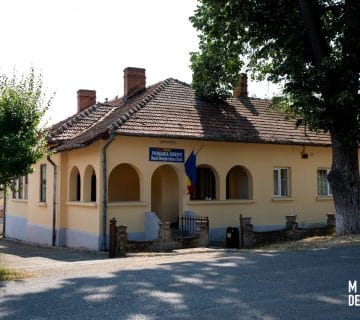


Nikolaus Lenau Memorial House and the Swabian Ethnographic Exhibition
Nikolaus Lenau (born Nikolaus Franz Niembsch von Strehlenau on 13 August 1802 in Csatád – today Lenauheim, Timiș County, Romania) is regarded as one of the most important Austrian Romantic poets of the 19th century and a key figure of German-language literature. He spent his early years in Hungary, in Pesta, Tokaj and Pressburg (Bratislava), mainly under the care of his grandparents. Between 1822 and 1832 he studied law, philosophy, agronomy and medicine in Vienna, though he never committed to a single profession, preferring the intellectual freedom of the literary world. The death of his mother in 1829 intensified the melancholy that would define much of his poetry. In Heidelberg, in 1831, he met poet Gustav Schwab, who helped publish Lenau’s first volume, Gedichte (Poems).
Restless by nature, Lenau travelled frequently across Central Europe. In 1832 he journeyed to America hoping to become a farmer, but returned disillusioned after a year. He lived mainly between Stuttgart and Vienna, forming a deep emotional attachment to Sophie Löwenthal, whose presence inspired many of his works. During this period he wrote his major creations: Faust (1836), Savonarola (1837), Die Albigenser (1842) and Don Juan (1844). In 1844 he suffered a stroke, followed by a progressive mental decline. Lenau spent his final years in psychiatric institutions and passed away on 22 August 1850 in Oberdöbling, Vienna. In German literature he is often associated with Weltschmerz (“world-weariness”), and many composers—including Schumann, Liszt, Fanny Mendelssohn and Richard Strauss—set his poems to music.
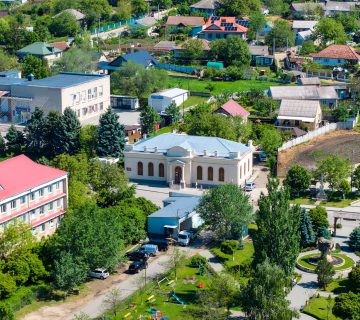
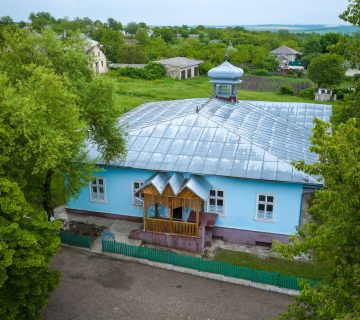
The Nikolaus Lenau Memorial House in Lenauheim was established in 1932 inside a historic building constructed in 1775, now listed as a heritage monument. It preserves rare manuscripts, editions of Lenau’s works, photographs, press clippings, busts and documentary materials illustrating his life and legacy. Alongside the literary collection, the museum hosts a Swabian ethnographic exhibition, recreating traditional 19th-century Banat interiors—kitchen, pantry and bedroom—and displaying tools, household items and agricultural equipment. A remarkable highlight is the collection of 51 traditional Swabian costume dolls, representing villages across the Banat region. The memorial house stands today as a cultural landmark that honours both the poet’s European legacy and the heritage of the Banat Swabian community.
LOCATION
Lenauheim commune, Timiș county
Google Maps
Interactive 3D Virtual Tour
To explore this virtual tour in detail, we invite you to use the navigation tools located in the bottom left corner, and the “Help” button in the bottom right corner will open a detailed navigation guide.
Interactive 3D Virtual Tour - Nikolaus Lenau Memorial House and the Swabian Ethnographic Exhibition
Presentation video
For more videos, we invite you to subscribe for free to our YouTube channel.